Directed by Dr. David Gilman Romano
    AML Home  |  Projects  |  Methodology  |  News  |  People  |  History  |  Training  | GIS @ Penn  |  Blogs  |  Seminars & Conferences  | Advisory Board  |  Contact

Archaeological Mapping Lab
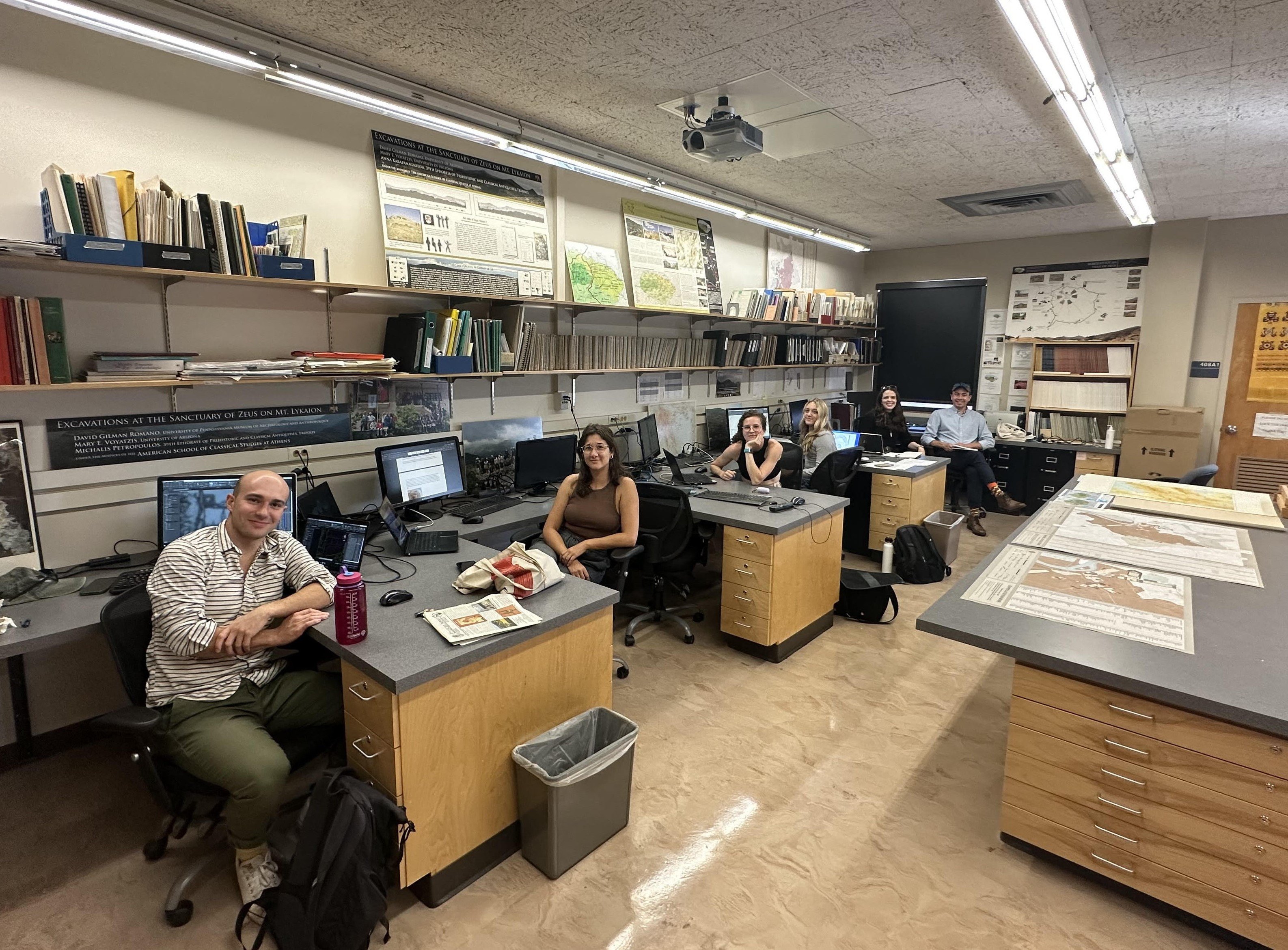
The Archaeological Mapping Lab is dedicated to the scientific study and analysis of ancient cities, landscapes and sanctuaries by means of the use of digital cartography, GIS, remote sensing and other spatial analytical techniques. The purpose of the lab is to pursue archaeological mapping research projects as well as to train students in computerized mapping techniques. Each year the lab employs 10-14 undergraduate and graduate students to work on various ongoing projects. The students come from departments in the School of Arts and Sciences as well as from the School of Design. If you would like to become involved in the work of the lab please contact the Director, Dr. David Gilman Romano, at dromano@sas.upenn.edu.

Lab Hours: Monday - Friday 9am-5pm


Mt. Lykaion 2010 Field Season
The seventh field season, summer 2010, will have three major aspects, excavation, architectural documentation and topographical survey, in addition to ongoing geological, geophysical and historical surveys. The coming season will run from June 15 - August 3, 2010.
For more information, see the project website.
Mt. Lykaion Excavation and Survey Project
The Mt. Lykaion Project is a multidisciplinary archaeological excavation and survey project at the sanctuary site of Zeus on Mt. Lykaion, in the region of Arcadia in the Peloponnesos, Greece. Sponsored by the Greek Archaeological Service, Tripolis, in conjunction with the Penn Museum and the University of Arizona, this project began in 2004 and excavation will continue through 2010.


Parrhasian Heritage Park
The Mt. Lykaion Excavation and Survey Project has proposed the creation of a heritage area in the Western Peloponnesos of approximately 300 square kilometers. The idea of the heritage park would be to unify and protect a large number of ancient cities and sanctuaries that are located in Western Arcadia, Southern Elis and Northern Messenia and to create a series of paths and trails that would connect these areas so that modern visitors could easily visit them on foot. In addition a visitor's center would be created and information would be available regarding the fauna, flora, geology, history, as well as archaeology of the area. In antiquity much of the area was known as the Parrhasia, which is itself a Homeric place name.
Digital Corinth Synchronized Database Project
The ancient city of Corinth, Greece has been excavated since 1895, creating a vast accumulation of information that is being digitized. This phase of the project will design the tagging of digital components and the creation of tools and lesson plans that draw on the data to present learning opportunites on the architecture, city planning, social and religious life of the city of Corinth during the Roman occupation in 44 BC. By combining two separate databases, one in Philadelphia and one in Athens, Greece, applications may be built for K20 education and tools developed for archaeological research. Funded by the NEH Digital Humanities Start-up program.

Project page on MUSE.


Mapping Augustan Alexandria
A graduate seminar and research project is underway to create a new map of the city of Alexandria in the time of Augustus. Under the direction of Professor Lothar Haselberger and with the collaboration of Professor David Gilman Romano and the Archaeological Mapping Lab, together with graduate students and faculty colleagues, this project is progressing.
Digital Augustan Rome
Mapping Augustan Rome was an attempt to visualize as well as to document the city of Rome as it existed in A.D. 14. The project sought to bring together the archaeological, historical and literary evidence for the Augustan city, and resulted in a volume as well as maps. The digital version promises to bring together many sources of data on Augustan Rome not included in the book or in the paper maps. The gathering of new information and its conversion to a digital format will give a new kind of resource for the study of the Augustan city. The resulting digital successor will not only serve future scholars and students but will have the capability of being revised and updated. The first phase of this project can now be seen at the project website digtalaugustanrome.org


© David Gilman Romano